#include <XPSession.h>
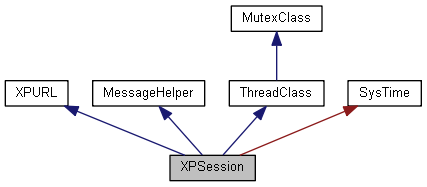
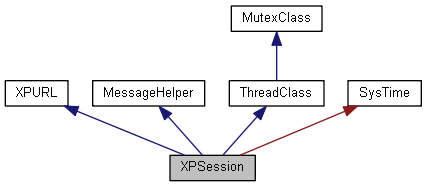
Public Types | |
| enum | Error { kXPSession_EOK = 0, kXPSession_EERROR = -1, kXPSession_ETRANSPORT_CLOSED = -2, kXPSession_ETRANSPORT_ERROR = -3 } |
| typedef int | GetSessionIDCallback (void *context) |
 Public Types inherited from MutexClass Public Types inherited from MutexClass | |
| enum | { kNoOwnerThread = -1 } |
Public Member Functions | |
| XPSession () | |
| virtual | ~XPSession () |
| void | Create (const std::string name) |
| void | Create (const std::string name, const std::string protocols) |
| std::string | ExportURL (const bool shortAddress=true) |
| void | Join (const std::string url) |
| void | Find (void) |
| void | Find (const std::string protocols) |
| std::string | EnumerateFound (void) |
| int | GetGameChannel (void) |
| void | SetGameChannel (const int channel=TransportAnyGameChannel) |
| int | GetSessionID (void) |
| bool | IsStable (void) |
| Error | GetStatus (void) |
| Error | GetSessionErrorReason (void) |
| void | DataSendToSession (const int sessionid, const char *data, const int length, const bool reliable=true, const bool certain=false, const bool ordered=false, const unsigned int band=0) |
| void | DataSendToSessionUnreliable (const int sessionid, const char *data, const int length) |
| void | DataSendToSessionOrdered (const int sessionid, const char *data, const int length, const unsigned int band=0) |
| void | DataSendToSessionReliable (const int sessionid, const char *data, const int length, const unsigned int band=0) |
| void | DataSendToSessionCertain (const int sessionid, const char *data, const int length) |
| bool | DataReceivePeek (int *const fromsessionid, int *const length, unsigned char *const type=0) |
| bool | DataReceive (int *const fromsessionid, char *const data, int *const length, unsigned char *const type=0) |
| bool | IsMaster (void) |
| int | GetJoiner (void) |
| int | GetLeaver (void) |
| SysTimeType | GetTime (void) |
| SysTimeType | GetLocalTime (void) |
| float | GetNetworkSendRate (void) |
| float | GetNetworkReceiveRate (void) |
| int | GetNetworkPacketsLost (void) |
| int | GetNetworkPacketsRejected (void) |
| void | Poll (void) |
| void | SetPollLayerBelow (bool enable=true) |
| bool | GetPollLayerBelow (void) |
| void | SetManualPoll (void) |
| void | SetAutomaticPoll (void) |
| void | SetManualPollXPURL (void) |
| void | SetAutomaticPollXPURL (void) |
| void | SetCanSpider (const bool canSpider=true) |
| bool | GetCanSpider (void) |
| void | SetCanBecomeMaster (const bool canBeMaster=true) |
| bool | GetCanBecomeMaster (void) |
| float | GetLatencyToMasterSession (void) |
| float | GetLatencyToSessionID (const int sessionID) |
| void | SetLatencyRecalculationDelay (const float seconds=1.0f) |
| void | SetEncryption (const bool enable=false) |
| bool | GetEncryption (void) |
| void | Disconnect (const int sessionID=kXPSessionUnknownID) |
| bool | GetPreConnectStatus (void) |
| void | SetPreConnect (const bool enable=false) |
| bool | GetPreConnect (void) |
| void | PreConnectHasFinished (void) |
| void | SetAutomaticPacketCompression (const bool enable=false) |
| bool | GetAutomaticPacketCompression (void) |
| void | GetCompressionStatistics (int *const before=0, int *const after=0, const bool reset=false) |
| void | GetMergedStatistics (int *const sent=0, int *const received=0, const bool reset=false) |
| int | GetMasterSessionID (void) |
| std::string | GetURLFromSessionID (const int sessionID) |
| void | SetClientOnly (const bool isClient=false) |
| bool | GetClientOnly (void) |
| bool | GetBandwidthFromSessionID (const int sessionID, Transport::Bandwidth *const bandwidth, int *const output, int *const input) |
| void | SetAllowConnections (const bool allow=true) |
| bool | GetAllowConnections (void) |
| void | SetNodeBuffers (const bool enable=false) |
| bool | GetNodeBuffers (void) |
| void | RegisterSessionIDCallback (GetSessionIDCallback *callback=0, void *context=0) |
| void | SetProxyMode (const bool enable=false) |
| bool | GetProxyMode (void) |
| void | SetMaximumDataSize (const int bytes=64 *1024) |
| int | GetMaximumDataSize (void) const |
| void | SetPacketCompressionLevel (const int level=10) |
| void | SetLargePacketCompressionLevel (const int level=5) |
| int | GetPacketCompressionLevel (void) const |
| int | GetLargePacketCompressionLevel (void) const |
| void | SetTransparentPacketCompression (const int level=0) |
| int | GetTransparentPacketCompression (void) |
| Public Member Functions inherited from XPURL | |
| XPURL () | |
| virtual | ~XPURL () |
| void | BeginEnumerateTransports (void) |
| Transport * | EnumerateTransports (void) |
| std::string | ParseURLs (const std::string urls) |
| void | Poll (void) |
| void | SetManualPoll (void) |
| void | SetAutomaticPoll (void) |
| Public Member Functions inherited from MessageHelper | |
| MessageHelper () | |
| virtual | ~MessageHelper () |
| void | SetBuffer (void *const buffer) |
| void * | GetBuffer (void) const |
| void * | GetCurrentPosition (void) const |
| virtual void | AddVariable (const void *variable, const int size) |
| virtual void | AddData (const void *data, const int size) |
| void | GetVariable (void *const variable, const int size) |
| void | GetData (void *const data, const int size) |
| void | SkipData (const int size) |
| int | GetSize (void) const |
| void | SetSize (const int size) |
| void | AddInteger (const int value) |
| void | AddFloat (const float value) |
| int | GetInteger (void) |
| float | GetFloat (void) |
| std::string | DumpAsHex (const bool csv=true) const |
| void | SetGuardSize (const int size=-1) |
| void | SanityCheckGuardSize (const int newSize=0) |
| int | GetLastSizeAdded (void) const |
| template<typename T > | |
| void | operator<< (const T &rhs) |
| template<typename T > | |
| void | operator>> (T &rhs) |
| void | operator<< (const char *rhs) |
| void | operator<< (const std::string &rhs) |
| void | operator>> (std::string &rhs) |
| void | operator<< (const bool &rhs) |
| void | operator>> (bool &rhs) |
| Public Member Functions inherited from ThreadClass | |
| ThreadClass () | |
| virtual | ~ThreadClass () |
| void | Sleep (int milliseconds) |
| Public Member Functions inherited from MutexClass | |
| MutexClass () | |
| virtual | ~MutexClass () |
| void | Lock (void) |
| void | UnLock (void) |
Static Public Member Functions | |
| static XPSession * | Allocate (void) |
| Static Public Member Functions inherited from XPURL | |
| static void | RegisterTransport (Transport &transport) |
| static void | RegisterDefaultTransports (void) |
| static Transport * | FindTransport (const std::string url) |
| static bool | FreeTransport (Transport *transport) |
| static void | InitialiseNetwork (const bool hardware=false) |
| static void | ShutdownNetwork (const bool hardware=false) |
| static DebugHandler * | RegisterDebugHandler (DebugHandler *debugHandler=0) |
| static DebugHandler * | GetDebugHandler (void) |
| Static Public Member Functions inherited from MessageHelper | |
| static void | AddVariable (void *buffer, const void *variable, const int size) |
| Adds data to a buffer with endian checking. | |
| static void | GetVariable (const void *buffer, void *const variable, const int size) |
| Adds data from a buffer with endian checking. | |
| static int | GetInt (const void *buffer, const int offset) |
| static short | GetShort (const void *buffer, const int offset) |
| static void | SetInt (void *buffer, const int offset, const int value) |
| static void | SetShort (void *buffer, const int offset, const short value) |
| static std::string | DumpAsHex (const void *data, const int size, const bool csv=true) |
Friends | |
| struct | Route |
Additional Inherited Members | |
| Protected Member Functions inherited from ThreadClass | |
| void | DoQuitNow (const int returnCode) |
| virtual void | ThreadExiting (const int returnCode) |
| void | CheckQuit (void) |
| Static Protected Member Functions inherited from ThreadClass | |
| static size_t | GetNumAllocated (void) |
| Protected Attributes inherited from MessageHelper | |
| int | mLastSizeAdded |
Detailed Description
A network session class. This handles session nodes joining and leaving a session.
This is a general purpose class for interfacing with the known transports and maintaining a stable interface between various connected nodes. This class enables packets of data to be sent to a specific session node ID or to all session nodes as a broadcast. A session node is usually an individual computer or instance of this class. In addition to this the class also offers a standard time interface that gives a synchronised shared between all connected nodes. Sessions also have the option to make spider connections to other sessions directly. If enabled this means that sessions will attempt to use the shortest and quickest route for messages rather than relaying all messages through the master session. What this means in the real world is that a session that uses SetCanSpider(true) is advertising its self as being able to accept connections from other peers in the network topology. When a new session joins a spidering session will be told the new session has joined and advertise the peer connection service. If there is a fault with one of the session then the remaining sessions, if they have peer connections, will still be able to send messages around the gap in the network topology. Another session is then chosen to be the new overall session master. An XPSession is used as the main basis for a ReplicaNet session.
The terms "Reliable", "Unreliable" and "Certain" are references to the three packet delivery types used by ReplicaNet, XPSession and XPURL Transport classes.
"Reliable" guarantees delivery of data in the same order it was sent.
"Certain" guarantees delivery of data but the order the data is received may not be preserved.
"Unreliable" does not guarantee delivery of data and the order of the data when it is received may not be preserved.
In general it is a good idea to not use too many "Reliable" updates because this method is quite expensive in terms of network and memory performance. If one packet gets lost it will delay the delivery of all other Reliable data until that packet is resent. The better choice would be to use "Certain" because this is less expensive in terms of memory and network performance. Also if one Certain packet is lost the delivery of other Certain packets is not delayed. Generally use Reliable for those events that absolutely must occur in the same order they were sent.
Member Enumeration Documentation
| enum Error |
Standard XPSession errors
| Enumerator | |
|---|---|
| kXPSession_EOK |
No error |
| kXPSession_EERROR |
A fatal error happened, like the connection broke and cannot be recovered |
Constructor & Destructor Documentation
Member Function Documentation
|
static |
Allocates a new session to be used
- Returns
- the new session that is allocated
| void Create | ( | const std::string | name | ) |
Creates a new session using the default available protocols.
When this XPSession instance is disconnected from a session this XPSession instance should be deleted and a new instance allocated before attempting to create or join a session.
- Parameters
-
name The name to give to this session. The maximum length of this string is 128 characters.
| void Create | ( | const std::string | name, |
| const std::string | protocols | ||
| ) |
Creates a new session using the supplied protocols
When this XPSession instance is disconnected from a session this XPSession instance should be deleted and a new instance allocated before attempting to create or join a session.
- Parameters
-
name The name to give to this session protocols The list of protocols to use separated by commas. e.g. "UDP@,STREAMTCPIP@"
| bool DataReceive | ( | int *const | fromsessionid, |
| char *const | data, | ||
| int *const | length, | ||
| unsigned char *const | type = 0 |
||
| ) |
Receives data and responds with what session sent this data.
- Parameters
-
fromsessionid the session id that sent this data. data the buffer for the data. length the length of the data received. type a pointer that can receive the packet type. This will be kXPSessionPacketType_Unreliable, kXPSessionPacketType_Certain, kXPSessionPacketType_Reliable or kXPSessionPacketType_Ordered. This parameter can be null in which case the type is not filled in. The default value for this pointer is null.
- Returns
- returns true if data was received. If false the entry parameters to this function are unchanged.
| bool DataReceivePeek | ( | int *const | fromsessionid, |
| int *const | length, | ||
| unsigned char *const | type = 0 |
||
| ) |
This allows the parameters of the next pending received data to be read. The data is left waiting to be read by DataReceive.
- Parameters
-
fromsessionid the session id that sent this data. length the length of the data received. type a pointer that can receive the packet type. This will be kXPSessionPacketType_Unreliable, kXPSessionPacketType_Certain, kXPSessionPacketType_Reliable or kXPSessionPacketType_Ordered. This parameter can be null in which case the type is not filled in. The default value for this pointer is null.
- Returns
- returns true if data was received. If false the entry parameters to this function are unchanged.
| void DataSendToSession | ( | const int | sessionid, |
| const char * | data, | ||
| const int | length, | ||
| const bool | reliable = true, |
||
| const bool | certain = false, |
||
| const bool | ordered = false, |
||
| const unsigned int | band = 0 |
||
| ) |
Sends data from this session to any other session via its ID or to all sessions by using XPSessionBroadcastID. If the node is in a pre-connect state and wants to send data to the master session then use kXPSessionUnknownID as the session ID to send to.
Data packets larger than 512 bytes can be sent and received correctly however these large packets may cause a performance hit as the large chunk of data is sent. Transport::GetMaxPacketSize() is used with the current connection instance to calculate if a packet needs to be sent as chunks. A sessionID will not receive any data sent to itself either by using its own sessionID or from a broadcast.
The other functions DataSendToSessionXXX use this function
- Parameters
-
sessionid the session id to send to or XPSessionBroadcastID. data the pointer to the data to send length the length of the data to send. reliable a flag to make this packet reliable, the default is true certain a flag to make this packet certain, the default is false ordered a flag to make this packet ordered, the default is false band The band to use for the underlying Transport when sending with the Reliable method.
| void DataSendToSessionCertain | ( | const int | sessionid, |
| const char * | data, | ||
| const int | length | ||
| ) |
Sends data using the 'Certain' packet type from this session to any other session via it's ID or to all sessions by using XPSessionBroadcastID
- Parameters
-
sessionid the session id to send to or XPSessionBroadcastID data the pointer to the data to send length the length of the data to send.
| void DataSendToSessionOrdered | ( | const int | sessionid, |
| const char * | data, | ||
| const int | length, | ||
| const unsigned int | band = 0 |
||
| ) |
Sends data using the 'Unreliable ordered' packet type from this session to any other session via it's ID or to all sessions by using XPSessionBroadcastID
- Parameters
-
sessionid the session id to send to or XPSessionBroadcastID data the pointer to the data to send. length the length of the data to send. band The band to use for the underlying Transport when sending with the Reliable method.
| void DataSendToSessionReliable | ( | const int | sessionid, |
| const char * | data, | ||
| const int | length, | ||
| const unsigned int | band = 0 |
||
| ) |
Sends data using the 'Reliable' packet type from this session to any other session via it's ID or to all sessions by using XPSessionBroadcastID
- Parameters
-
sessionid the session id to send to or XPSessionBroadcastID data the pointer to the data to send. length the length of the data to send. band The band to use for the underlying Transport when sending with the Reliable method.
| void DataSendToSessionUnreliable | ( | const int | sessionid, |
| const char * | data, | ||
| const int | length | ||
| ) |
Sends data using the 'Unreliable' packet type from this session to any other session via it's ID or to all sessions by using XPSessionBroadcastID
- Parameters
-
sessionid the session id to send to or XPSessionBroadcastID data the pointer to the data to send. length the length of the data to send.
| void Disconnect | ( | const int | sessionID = kXPSessionUnknownID | ) |
This forces a disconnect from the supplied sessionID or if the sessionID is not supplied then all session nodes are disconnected. The disconnect is immediate and initiates the fault tolerant mechanism for XPSession and ReplicaNet on other connected session nodes. This means if the session was a master session node then the other session nodes will try to find a new master if this mechanism is enabled. In the case of a ReplicaNet session node having objects, these objects will attempt to use the fault recovery and migration to other nodes if it is enabled.
- Parameters
-
sessionID The sessionID to disconnect from. The default is to disconnect from all sessionIDs.
| std::string EnumerateFound | ( | void | ) |
Enumerates any found sessions
- Returns
- the URL of a session or a "" string
| std::string ExportURL | ( | const bool | shortAddress = true | ) |
Exports a URL that can be used to connect to this session in future. The format of the URL is as follows:
"SESSION://" the URL header.
Any number of exported Transport URLs separated with a '/'. Transport URLs are in the format "Transport type""address"
The standard XPSession brace block which contains: {SESSIONNAME=<session name>="">}
Any number of user defined brace blocks.
An example is as follows: SESSION://UDP@127.0.0.1:4000/{SESSIONNAME=Game}
- Parameters
-
shortAddress If this is true then only the short address for this session is exported. The short address only contains the address of the master listen transports, the long address also contains the listen addresses for the spider connections if they are available. By default the short address is exported.
- Returns
- the URL for this session
| void Find | ( | void | ) |
Tries to find sessions using the default protocols
| void Find | ( | const std::string | protocols | ) |
Tries to find sessions using the listed protocols
- Parameters
-
protocols The list of protocols to use separated by commas. e.g. "UDP@,STREAMTCPIP@"
| bool GetAllowConnections | ( | void | ) |
Returns the value configured by SetAllowConnections() the value.
| bool GetAutomaticPacketCompression | ( | void | ) |
Gets the value configured by SetAutomaticPacketCompression()
- Returns
- Returns true if the automatic packet compression is enabled.
| bool GetBandwidthFromSessionID | ( | const int | sessionID, |
| Transport::Bandwidth *const | bandwidth, | ||
| int *const | output, | ||
| int *const | input | ||
| ) |
Attempts to read the configured bandwidth for a route to a specific session ID. If the session ID is not directly connected to this node then this function will return false and the contents of the output and input pointers will be left unchanged. If this node can supply bandwidth information about a session ID then this function will return true and the bandwidth, output, input pointers will contain the values as used by SetBandwidthLimit(), SetMaximumOutputBandwidth() and SetMaximumInputBandwidth(). Note that output and input bandwidth will appear to be exchanged because the output of one end of transport connection is really the input of the other end of the connection.
Note: This function can take some time to execute when there are hundreds of connected users.
- Parameters
-
sessionID The session ID of the required node. bandwidth A pointer to accept the Transport::Bandwidth value, this can be null. output A pointer to accept the output bandwidth value, this can be null. input A pointer to accept the input bandwidth value, this can be null.
- Returns
- Success returns true, failure returns false.
| bool GetCanBecomeMaster | ( | void | ) |
Allows the state to be read
- Returns
- the status of the becoming a master state
| bool GetCanSpider | ( | void | ) |
This allows the spidering state to be read /return the status of the spidering state
| bool GetClientOnly | ( | void | ) |
Gets the client only configuration set by SetClientOnly().
- Returns
- The configuration set by SetClientOnly().
| void GetCompressionStatistics | ( | int *const | before = 0, |
| int *const | after = 0, |
||
| const bool | reset = false |
||
| ) |
Gets the compression statistics totals for packets sent from this session node.
- Parameters
-
before The total number of bytes before compression. This can be null. after The total number of bytes after compression. This can be null. reset If true, after returning the information to the caller both totals are reset back to zero. The default value is false.
| bool GetEncryption | ( | void | ) |
Gets the status of the encryption flag for this session
| int GetGameChannel | ( | void | ) |
Gets the current channel number for this session
- Returns
- the channel number
| int GetJoiner | ( | void | ) |
Gets the session id that recently joined the network session
- Returns
- the session id or kXPSessionUnknownID to indicate no more session ids changed
| float GetLatencyToMasterSession | ( | void | ) |
This allows the latency to the master session to be read. This is the time taken for a packet to reach the master session. This is half round trip ping time.
- Returns
- the latency to the master session
| float GetLatencyToSessionID | ( | const int | sessionID | ) |
This allows the latency to the sessionID to be read. This is the time taken for a packet to reach the sessionID. This is half round trip ping time.
- Returns
- the latency to the sessionID.
| int GetLeaver | ( | void | ) |
Gets the session id that left the network session
- Returns
- the session id or kXPSessionUnknownID to indicate no more session ids changed
| SysTimeType GetLocalTime | ( | void | ) |
Gets the current local time. This time is local to the session and is not synchronised to the session master clock.
- Returns
- the float time 1.0 units == 1 second
| int GetMasterSessionID | ( | void | ) |
Gets the master session unique ID. If the session is not connected then the return value is kXPSessionUnknownID.
- Returns
- the master session unique ID
| void GetMergedStatistics | ( | int *const | sent = 0, |
| int *const | received = 0, |
||
| const bool | reset = false |
||
| ) |
Gets the merged packet statistics totals for connections managed by this session node.
Note: This function can take some time to execute when there are hundreds of connected users.
- Parameters
-
sent The total number of merged sent packets. This can be null. received The total number of merged sent packets. This can be null. reset If true, after returning the information to the caller both totals are reset back to zero. The default value is false.
| int GetNetworkPacketsLost | ( | void | ) |
Gets the number of packets that are lost and lost and resent
- Returns
- number of packets
| int GetNetworkPacketsRejected | ( | void | ) |
Gets the number of packets that have been rejected due to failing the checksum, decryption of decompression checks.
- Returns
- number of packets
| float GetNetworkReceiveRate | ( | void | ) |
Gets the current network receive transfer rate in bytes per second
- Returns
- bytes per second
| float GetNetworkSendRate | ( | void | ) |
Gets the current network send transfer rate in bytes per second
- Returns
- bytes per second
| bool GetNodeBuffers | ( | void | ) |
Returns the value configured by SetNodeBuffers()
- Returns
- The value.
| bool GetPollLayerBelow | ( | void | ) |
Allows the state of SetPollLayerBelow() to be read. If the library is always single threading then this function will always return true.
- Returns
- the state of SetPollLayerBelow()
| bool GetPreConnect | ( | void | ) |
Gets the status of the pre-connect mechanism for this session node.
- Returns
- Returns true if the pre-connect mechanism is enabled.
| bool GetPreConnectStatus | ( | void | ) |
Allows the status of the pre-connect mechanism to be tested.
- Returns
- When GetPreConnectStatus() returns true after this session node starts a join then this session node is in a pre-connect state.
| Error GetSessionErrorReason | ( | void | ) |
This can be used to read extended information when XPSession encounters a session error.
- Returns
- The error can be:
kXPSession_EOK for when there is no session error.
kXPSession_EERROR for undefined errors.
kXPSession_ETRANSPORT_CLOSED for when the session is disconnected or closed.
kXPSession_ETRANSPORT_ERROR when the session is abnormally terminated due to a transport timeout.
| int GetSessionID | ( | void | ) |
Gets the session unique ID
- Returns
- the session unique ID
| Error GetStatus | ( | void | ) |
Gets the session status. A session error happens when the master session disconnects and a new master cannot be found.
- Returns
- the session status will be either kXPSession_EOK or kXPSession_EERROR.
| SysTimeType GetTime | ( | void | ) |
Gets the current system time of this ReplicaNet session synchronised with the time on the session master.
- Returns
- the float time 1.0 units == 1 second
| int GetTransparentPacketCompression | ( | void | ) |
Allows the setting for SetTransparentPacketCompression() to be read.
- Returns
- The setting for SetTransparentPacketCompression()
| std::string GetURLFromSessionID | ( | const int | sessionID | ) |
Attempts to resolve the URL of the session unique ID from the point of view of this session node. If the session unique ID is not known to the session then the result is a null string. If the session unique ID is not directly connected to this node, for example the spider connection was broken, then this function is not guaranteed to produce a URL and can return a null string.
- Returns
- The URL in the same format supplied by Transport::GetPeerURL()
| bool IsMaster | ( | void | ) |
Tests to see if this session is a master session
- Returns
- returns true is the session is a master session, false if not
| bool IsStable | ( | void | ) |
This allows the user o check if the session is really stable.
- Returns
- returns true if the session is stable
| void Join | ( | const std::string | url | ) |
| void Poll | ( | void | ) |
This polls XPSession. Normally an application will yield enough time during threads for XPSession to function. Sometimes an application that uses a lot of 3D graphics can lock out other threads for quite some time. In these cases you may call XPSession::Poll() to yield some time to XPSession to perform housekeeping.
Single threaded considerations:
When using the single threaded libraries this method should be called regularly. Unless ReplicaNet::Poll() is called in which case this Poll() method is already called.
| void PreConnectHasFinished | ( | void | ) |
If the pre-connect mechanism is enabled then this function must be called by the joining session node when packets have been exchanged to the satisfaction of the joining session node.
| void RegisterSessionIDCallback | ( | GetSessionIDCallback * | callback = 0, |
| void * | context = 0 |
||
| ) |
Registers a callback for the user to create their own sessionIDs. The handle can be used by the user to store context specific data and is passed to the registered callback function. The user must guarantee that the calculated sessionID is greater than 0 and less than 32768 and is unique for the entire network session.
| void SetAllowConnections | ( | const bool | allow = true | ) |
Enables or disables any further connection attempts to this session.
- Parameters
-
allow Set this to be true to allow connections to this session. False will stop any further connection attempts to this session and the connecting session will get kXPSession_ETRANSPORT_CLOSED from GetSessionErrorReason().
| void SetAutomaticPacketCompression | ( | const bool | enable = false | ) |
Enables or disables the automatic packet compression test. If enabled XPSession will test each packet sent to see if it can be compressed and if there is a space saving then the packet is compressed before sending.
- Parameters
-
enable Enable or disable automatic packet compression. The default is false to disable automatic packet compression.
| void SetAutomaticPoll | ( | void | ) |
Sets the automatic Poll() method In multi-threading libraries this restarts the automatic polling thread so that an application does not need the call Poll()
In single-threading libraries this method has no effect and does not start a thread.
The default multi-threading library behaviour is to enable multi-threading automatic polls,
The default single-threading library behaviour is to use manual polls,
| void SetAutomaticPollXPURL | ( | void | ) |
This allows the poll method to be set for the XPURL layer that is used by this session.
| void SetCanBecomeMaster | ( | const bool | canBeMaster = true | ) |
This allows the session to set if it can become a master due to a fault being found from another session
- Parameters
-
canBeMaster Pass in true to enable this session to become a master if needed.
The default is true
Currently a session can only become a master if it is enabled for spidering however.
| void SetCanSpider | ( | const bool | canSpider = true | ) |
This allows the user to enable or disable spidering of network connections
- Parameters
-
canSpider Pass in true to enable spidering or false to disable spidering
The default is true
| void SetClientOnly | ( | const bool | isClient = false | ) |
Sets the client only flag for this session node. The default value is false which means this node will get joiner and leaver messages. If this is set to be true then this node will only get joiner/leaver messages for spider nodes or nodes that can become master nodes. This must not be changed after the session is used for joining a session. Setting this to option to be true also automatically sets SetCanBecomeMaster() and SetCanSpider() to be false.
- Parameters
-
isClient The default value is false.
| void SetEncryption | ( | const bool | enable = false | ) |
Enables or disables encryption for this session
- Parameters
-
enable set this to be true to enable encryption for packets sent from this session. The default is false
| void SetGameChannel | ( | const int | channel = TransportAnyGameChannel | ) |
Sets the current channel number for this session. If no channel number is passed then TransportAnyGameChannel is used.
- Parameters
-
channel The channel number to use.
| void SetLargePacketCompressionLevel | ( | const int | level = 5 | ) |
Sets the compression level to use when compressing large session packets that are split into chunks.
| void SetLatencyRecalculationDelay | ( | const float | seconds = 1.0f | ) |
This allows the latency recalculation delay to be set. The default value is 1 second meaning there is a ping packet sent every second.
- Parameters
-
seconds The number of seconds before latency is recalculated.
| void SetManualPoll | ( | void | ) |
Sets the manual Poll() method for this class only.
For multi-threaded libraries this turns off the automatic polling method.
This allows an application to time exactly when polls are done.
The application must call Poll() on a regular basis. A good place is just before or after the frame update is done.
| void SetManualPollXPURL | ( | void | ) |
This allows the poll method to be set for the XPURL layer that is used by this session.
| void SetMaximumDataSize | ( | const int | bytes = 64 *1024 | ) |
Sets the maximum size of data that can be sent or received. If a session sends more data than the recipient is willing to receive then the recipient can decide to disconnect the source session connection.
| void SetNodeBuffers | ( | const bool | enable = false | ) |
Enables or disables buffering for this session node. With buffering enabled extra memory is used to improve multi-threaded performance when this node is used by another thread.
- Parameters
-
enable The default is false which disables extra buffering.
| void SetPacketCompressionLevel | ( | const int | level = 10 | ) |
Sets the compression level to use when compressing normal session packets.
| void SetPollLayerBelow | ( | bool | enable = true | ) |
This allows the user to determine if during a Poll() the layer below also gets called. For single threaded applications this function has no effect as the layer below always has the Poll() called. The default is true.
The layer below in this case is XPURL.
- Parameters
-
enable Enable or disable layer below polling.
| void SetPreConnect | ( | const bool | enable = false | ) |
Enables or disables the pre-connect mechanism for session nodes that are joining a session. When this mechanism is enabled the joining session node will be able to exchange packets with the master session node before the node properly joins the session. The function PreConnectHasFinished() can be called to signal that the node wishes to complete a connect to the session. This function should only be used before a session node is used to join the session. The function IsStable() will not return true until the pre-connect is finished.
The intended for this mechanism is as follows:
1) SetPreConnect(true) and attempts to join a session. All calls to GetSessionID() will return kXPSessionUnknownID until after this session finishes the pre-connect and the master session transmits the correct sessionID.
2) When GetPreConnectStatus() returns true after this session node starts a join then this session node is in a pre-connect state.
3) This node will send one or more user defined packets that signal that the session wants to exchange certain pre-connect data to the master session using DataSendToSession() and session ID kXPSessionUnknownID. Using the reliable packet type is recommended but not mandatory.
4) The master session will receive user data packets and detecting that pre-connect data has been received will in reply send a user data message to the effect that it has received this information.
5) The joining node receives pre-connect data from the master session, verifies the data and either completes the pre-connect by calling PreConnectHasFinished() or uses Disconnect() to abort the connection.
- Parameters
-
enable Set this to be true to enable the pre-connect mechanism for this session node. If false then the session node will discard all pre-connect packets and the preconnection mechanism is assumed to be disabled. The default is false.
| void SetTransparentPacketCompression | ( | const int | level = 0 | ) |
Instead of using discrete data compression for each data packet sent using XPSession, use the Transport packet compression instead. This can result in higher compression ratios. See Transport::SetTransparentPacketCompression() for more details. Note: If this compression method is enabled then use SetAutomaticPacketCompression(false) and SetEncryption(false) for best performance.