#include "RNPlatform/Inc/MemoryTracking.h"#include <stdlib.h>#include <assert.h>#include "RNPlatform/Inc/PlatformHeap.h"#include "RNPlatform/Inc/Rand.h"#include <stdio.h>#include <string.h>#include "RNXPSockets/debug.h"#include "RNXPSockets/Inc/XPSocket.h"#include "RNPlatform/Inc/ThreadClass.h"#include "RNPlatform/Inc/SysTime.h"#include <list>#include "RNXPSockets/Ping.h"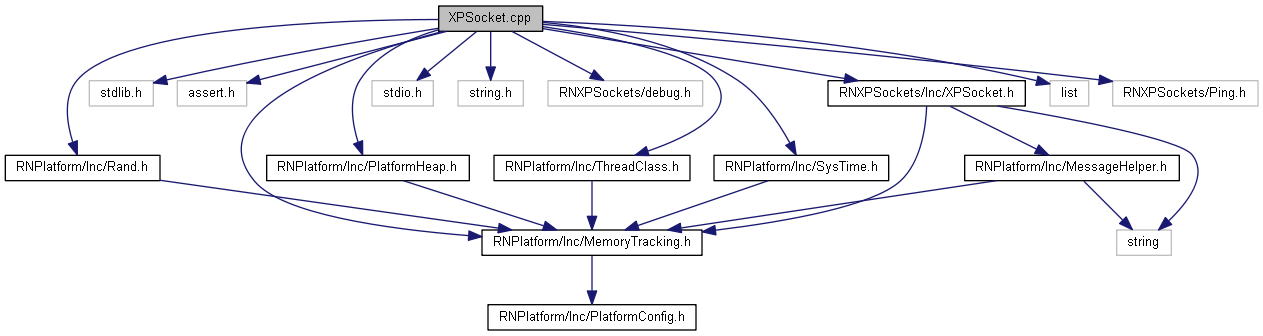
Classes | |
| class | XPSocketsHeapBlock |
| struct | ImpairedPacket |
Macros | |
| #define | RNmax(a, b) (((a) > (b)) ? (a) : (b)) |
| #define | RNmin(a, b) (((a) < (b)) ? (a) : (b)) |
| #define | closesocket close |
| #define | ioctlsocket ioctl |
| #define | SOCKET int |
| #define | INVALID_SOCKET -1 |
| #define | SOCKET_ERROR -1 |
| #define | WSAEWOULDBLOCK EWOULDBLOCK |
| #define | WSAECONNRESET ECONNRESET |
| #define | WSAENOTCONN ENOTCONN |
| #define | NO_NAGLE |
| #define | SOMAXCONN 0x7fffffff |
Functions | |
| int | WSAGetLastError (void) |
| void | XPSock_Poll (void) |
| void | XPSock_UpdatePerSecondMetrics (void) |
| int | XPSock_Init (void) |
| int | XPSock_Quit (void) |
| t_XPSocket * | XPSock_Create (void) |
| int | XPSock_SetSendBuffer (t_XPSocket *socket, int size) |
| int | XPSock_SetRecvBuffer (t_XPSocket *socket, int size) |
| int | XPSock_Connect (t_XPSocket *socket, const t_XPAddress *addr) |
| int | XPSock_Send (t_XPSocket *socket, const char *data, const int len) |
| int | XPSock_Recv (t_XPSocket *socket, char *data, int maxlen, int flag) |
| int | XPSock_Close (t_XPSocket *socket) |
| int | XPSock_Listen (t_XPSocket *socket, int port) |
| int | XPSock_Listen (t_XPSocket *socket, const RNReplicaNet::t_XPAddress *addr) |
| t_XPSocket * | XPSock_Accept (t_XPSocket *socket) |
| int | XPSock_GetAddress (t_XPSocket *socket, t_XPAddress *addr) |
| int | XPSock_GetPeerAddress (t_XPSocket *socket, t_XPAddress *addr) |
| t_XPSocket * | XPSock_UrgentCreate (int port) |
| t_XPSocket * | XPSock_UrgentCreate (const RNReplicaNet::t_XPAddress *addr) |
| int | XPSock_UrgentMakeBroadcast (t_XPSocket *socket) |
| int | XPSock_UrgentSend (t_XPSocket *socket, const char *data, int len, const t_XPAddress *addr) |
| int | XPSock_UrgentRecv (t_XPSocket *socket, char *const data, int maxlen, int flag, t_XPAddress *const addr) |
| const char * | XPSock_TranslateError (int error) |
| const char * | XPSock_TranslateErrorLong (int error) |
| int | XPSock_GetHostName (char *name, int name_len) |
| int | XPSock_GetHostAddress (XPAddress *addr) |
| int | XPSock_Resolve (t_XPAddress *resolve, const char *input) |
| void | XPSock_SentHistogram (unsigned int *classes, int numClasses) |
| void | XPSock_RecvHistogram (unsigned int *classes, int numClasses) |
| int | XPSock_GetHardwareStatus (void) |
| t_XPSocket * | XPSock_ICMPCreate (void) |
| int | XPSock_ICMPSendPing (RNReplicaNet::t_XPSocket *socket, const RNReplicaNet::t_XPAddress *addr, unsigned short *retID, unsigned short *retSeq, unsigned int *retTimeSent) |
| int | XPSock_ICMPRecvPing (RNReplicaNet::t_XPSocket *socket, RNReplicaNet::t_XPAddress *const addr, unsigned short *retID, unsigned short *retSeq, unsigned int *retTimeElapsed) |
| int | XPSock_ICMPWaitForPing (RNReplicaNet::t_XPSocket *socket, const float timeoutSeconds) |
| int | XPSock_GetSocketSelectMaxSize (void) |
| int | XPSock_SocketSelect (RNReplicaNet::t_XPSocket **sockets, const int numSockets, const int milliseconds) |
Variables | |
| int | asocket_lasterror = XPSOCK_EOK |
| int | asocket_packets_got = 0 |
| int | asocket_packets_sent = 0 |
| int | asocket_packets_got_size = 0 |
| int | asocket_packets_sent_size = 0 |
| float | asocket_packets_got_size_per_second = 0.0f |
| float | asocket_packets_sent_size_per_second = 0.0f |
| float | asocket_packets_got_per_second = 0.0f |
| float | asocket_packets_sent_per_second = 0.0f |
| MutexClass | g_xpsockets_lockclass |
| bool | gXPSock_PacketLossEmulation = false |
| float | gXPSock_PacketLossEmulationPercent = 0.0f |
| bool | gXPSock_PacketLatencyEmulation = false |
| float | gXPSock_PacketLatencyEmulationBase = 0.0f |
| float | gXPSock_PacketLatencyEmulationJitter = 0.0f |
| int | gXPSock_UDPProtoParameter = IPPROTO_UDP |
Detailed Description
Simple local host packet stuff A lot like standard sockets, but made simpler with all the error handling done internally
Handles all these protocols transparently:
Localhost sockets. TCPIP using streamed and UDP connections.
Sockets with a permanent connection and also connectionless sockets are implemented. Every urgent socket call can be thought of as mapping to equivalent UDP packet protocols.
Macro Definition Documentation
| #define NO_NAGLE |
Use this to turn off the Nagle packet compression algorithm
Function Documentation
| t_XPSocket* XPSock_Accept | ( | t_XPSocket * | socket | ) |
Tries to accept any incoming connections and creates a connected socket if successful.
- Parameters
-
socket the socket pointer
- Returns
- returns the new socket connection that got accepted or an XPSOCK error code or null for no socket
References XPAddress::addr, s_XPSocket::addr, asocket_lasterror, s_XPSocket::loopback_recvbuffer, XPAddress::port, s_XPSocket::state, s_XPSocket::total_accepts, s_XPSocket::type, s_XPSocket::wins_socket, XPSock_Close(), and XPSock_Create().
Referenced by XPSocket::Accept().
| int XPSock_Close | ( | t_XPSocket * | socket | ) |
Closes a socket
- Parameters
-
socket the socket pointer
- Returns
- returns an XPSOCK error code, XPSOCK_EOK is no error.
References asocket_lasterror, s_XPSocket::loopback_recvbuffer, s_XPSocket::state, s_XPSocket::type, s_XPSocket::wins_socket, and s_XPSocket::wins_socket6.
Referenced by XPSocket::Close(), XPSocket::MutateSocket(), XPSock_Accept(), and XPSock_Connect().
| int XPSock_Connect | ( | t_XPSocket * | socket, |
| const t_XPAddress * | addr | ||
| ) |
Connect to a machine address
- Parameters
-
socket the socket pointer addr the address to connect to. If addr is NULL then a local connect is tried
- Returns
- returns an XPSOCK error code, XPSOCK_EOK is no error.
References XPAddress::addr, s_XPSocket::addr, asocket_lasterror, s_XPSocket::loopback_recvbuffer, XPAddress::port, s_XPSocket::state, s_XPSocket::type, s_XPSocket::wins_socket, and XPSock_Close().
Referenced by XPSocket::Connect().
| t_XPSocket* XPSock_Create | ( | void | ) |
Creates a socket
- Returns
- returns the socket pointer or XPSOCK_EERROR if an error occurred
References asocket_lasterror, s_XPSocket::wins_socket, and s_XPSocket::wins_socket6.
Referenced by XPSocket::Create(), and XPSock_Accept().
| int XPSock_GetAddress | ( | t_XPSocket * | socket, |
| t_XPAddress * | addr | ||
| ) |
Fills in the internet address and port of a socket to the address structure.
- Parameters
-
socket the socket pointer addr the address structure to fill in
- Returns
- returns XPSOCK_EOK or an XPSOCK error code.
References XPAddress::addr, XPAddress::addr6, asocket_lasterror, XPAddress::port, XPAddress::port6, s_XPSocket::wins_socket, s_XPSocket::wins_socket6, and XPSock_GetHostAddress().
Referenced by XPSocket::GetAddress().
| int XPSock_GetHardwareStatus | ( | void | ) |
Gets the status of the network hardware used by this socket interface.
- Returns
| int XPSock_GetHostAddress | ( | XPAddress * | addr | ) |
Gets the host machine address
- Parameters
-
addr the XPAddress to fill in
- Returns
- returns an XPSOCK error code.
References XPSock_GetHostName(), and XPSock_Resolve().
Referenced by XPSock_GetAddress().
| int XPSock_GetHostName | ( | char * | name, |
| int | name_len | ||
| ) |
Gets the host machine name
- Parameters
-
name pointer to a buffer to receive the machines textual name name_len the length of the buffer
- Returns
- returns an XPSOCK error code.
References asocket_lasterror.
Referenced by XPSock_GetHostAddress().
| int XPSock_GetPeerAddress | ( | t_XPSocket * | socket, |
| t_XPAddress * | addr | ||
| ) |
Fills in the internet address of the peer of a socket to the address structure.
- Parameters
-
socket the socket pointer addr the address structure to fill in
- Returns
- returns XPSOCK_EOK or an XPSOCK error code.
References XPAddress::addr, asocket_lasterror, XPAddress::port, and s_XPSocket::wins_socket.
Referenced by XPSocket::GetPeerAddress().
| int XPSock_Init | ( | void | ) |
This inits the socket interface
References asocket_lasterror, and SysTime::FloatTime().
Referenced by MyService::Main(), and XPSocket::XPSocket().
| int XPSock_Listen | ( | t_XPSocket * | socket, |
| int | port | ||
| ) |
Sets a socket to be a listen socket for a certain port number. This should only really be used for a server not the client as it is better network programming practice.
- Parameters
-
socket the socket pointer port the port number to listen from
- Returns
- returns an XPSOCK error code, XPSOCK_EOK is no error.
References XPAddress::MakeAny().
Referenced by XPSocket::Listen().
| int XPSock_Listen | ( | t_XPSocket * | socket, |
| const RNReplicaNet::t_XPAddress * | addr | ||
| ) |
Sets a socket to be a listen socket that is bound to the address supplied. This should only really be used for a server not the client as it is better network programming practice.
- Parameters
-
socket the socket pointer addr the address to use.
- Returns
- returns an XPSOCK error code, XPSOCK_EOK is no error.
References XPAddress::addr, asocket_lasterror, XPAddress::port, s_XPSocket::port, s_XPSocket::state, s_XPSocket::type, and s_XPSocket::wins_socket.
| int XPSock_Quit | ( | void | ) |
Quits all sockets and exits Calling PlatformHeap::ForceFree() will call XPSock_Quit() if XPSock_Init() was previously called.
References asocket_lasterror.
| int XPSock_Recv | ( | t_XPSocket * | socket, |
| char * | data, | ||
| int | maxlen, | ||
| int | flag | ||
| ) |
Tries to receive data from a socket
- Parameters
-
socket the socket pointer data a char pointer to the data buffer maxlen the maximum length of the data buffer to receive to flag the flag to use for this operation. Removes the read message from the queue unless XPSOCKF_PEEK is used
- Returns
- returns the number of bytes read or 0 if no data is pending or an XPSOCK_EERROR error code.
References asocket_lasterror, asocket_packets_got, asocket_packets_got_size, s_XPSocket::loopback_pending, s_XPSocket::loopback_readpos, s_XPSocket::loopback_recvbuffer, s_XPSocket::state, s_XPSocket::type, and s_XPSocket::wins_socket.
Referenced by XPSocket::Recv().
| void XPSock_RecvHistogram | ( | unsigned int * | classes, |
| int | numClasses | ||
| ) |
Supplies a histogram table and the size of the table for sent packets. Each class entry corresponds to a size of packet.
- Parameters
-
classes The pointer to the array of classes. numClasses The number of classes in the array.
| int XPSock_Resolve | ( | t_XPAddress * | resolve, |
| const char * | input | ||
| ) |
Handy routine to resolve anything into an address
- Parameters
-
resolve the address structure to fill in with the result. Specifically the port and port6 members are left unchanged. input the textual name of a machine name to resolve
- Returns
- returns an XPSOCK error code.
References XPAddress::addr, XPAddress::addr6, and asocket_lasterror.
Referenced by XPSock_GetHostAddress().
| int XPSock_Send | ( | t_XPSocket * | socket, |
| const char * | data, | ||
| const int | len | ||
| ) |
Tries to send data via the socket
- Parameters
-
socket the socket pointer data a char pointer to the data buffer len the length of the data to send
- Returns
- returns The number of bytes sent or an SOCKET_ERROR error code, XPSOCK_EOK is no error.
References asocket_lasterror, asocket_packets_sent, asocket_packets_sent_size, s_XPSocket::loopback_pending, s_XPSocket::loopback_recvbuffer, s_XPSocket::loopback_recvpos, s_XPSocket::state, s_XPSocket::type, and s_XPSocket::wins_socket.
Referenced by XPSocket::Send().
| void XPSock_SentHistogram | ( | unsigned int * | classes, |
| int | numClasses | ||
| ) |
Supplies a histogram table and the size of the table for sent packets. Each class entry corresponds to a size of packet.
- Parameters
-
classes The pointer to the array of classes. numClasses The number of classes in the array.
| int XPSock_SetRecvBuffer | ( | t_XPSocket * | socket, |
| int | size | ||
| ) |
Sets the size of the recv buffer for a socket
- Parameters
-
socket the socket pointer size The size to set the recv buffer to or -1 to only return the value
- Returns
- the new size of the recv buffer
References s_XPSocket::wins_socket.
Referenced by XPSocket::SetRecvBuffer().
| int XPSock_SetSendBuffer | ( | t_XPSocket * | socket, |
| int | size | ||
| ) |
Sets the size of the send buffer for a socket
- Parameters
-
socket the socket pointer size The size to set the send buffer to or -1 to only return the value
- Returns
- the new size of the send buffer
References s_XPSocket::wins_socket.
Referenced by XPSocket::SetSendBuffer().
| const char* XPSock_TranslateError | ( | int | error | ) |
This translates an XPSocket error to a text string
- Parameters
-
error the XPSOCK error number
- Returns
- returns a pointer to an XPSOCK error string.
References s_XPErrorTranslate::text.
| const char* XPSock_TranslateErrorLong | ( | int | error | ) |
This translates an XPSocket error to a long descriptive text string
- Parameters
-
error the XPSOCK error number
- Returns
- returns a pointer to an XPSOCK long error string.
References s_XPErrorTranslate::longtext.
| void XPSock_UpdatePerSecondMetrics | ( | void | ) |
This is automatically called by other ReplicaNet modules using the XPURL Transport system
References asocket_packets_got, asocket_packets_got_per_second, asocket_packets_got_size, asocket_packets_got_size_per_second, asocket_packets_sent, asocket_packets_sent_per_second, asocket_packets_sent_size, asocket_packets_sent_size_per_second, SysTime::FloatTime(), and SysTime::Reset().
| t_XPSocket* XPSock_UrgentCreate | ( | int | port | ) |
Creates an urgent socket Returns XPSOCK_EERROR if an error occurred If port is zero (0) then the network layer will pick a port number to be bound to Using a value of zero for the port when operating a client is advised since the any chosen port might already be in use
- Parameters
-
port the port number to use
- Returns
- returns a pointer to new socket or an XPSOCK error code.
References XPAddress::MakeAny().
Referenced by XPSocketUrgent::Create(), and MyService::Main().
| t_XPSocket* XPSock_UrgentCreate | ( | const RNReplicaNet::t_XPAddress * | addr | ) |
Creates an urgent socket that is bound to the address supplied. Returns XPSOCK_EERROR if an error occurred If port is zero (0) then the network layer will pick a port number to be bound to Using a value of zero for the port when operating a client is advised since the any chosen port might already be in use
- Parameters
-
addr the address to use.
- Returns
- returns a pointer to new socket or an XPSOCK error code.
References XPAddress::addr, XPAddress::addr6, asocket_lasterror, XPAddress::port, s_XPSocket::port, XPAddress::port6, s_XPSocket::port6, s_XPSocket::wins_socket, and s_XPSocket::wins_socket6.
| int XPSock_UrgentMakeBroadcast | ( | t_XPSocket * | socket | ) |
Makes an urgent socket broadcast capable
- Parameters
-
socket the socket pointer
- Returns
- returns an XPSOCK error code.
References asocket_lasterror, s_XPSocket::wins_socket, and s_XPSocket::wins_socket6.
Referenced by XPSocketUrgent::MakeBroadcast().
| int XPSock_UrgentRecv | ( | t_XPSocket * | socket, |
| char *const | data, | ||
| int | maxlen, | ||
| int | flag, | ||
| t_XPAddress *const | addr | ||
| ) |
Receives data from an urgent socket
- Parameters
-
socket the socket pointer data pointer to a data buffer maximum length of the data buffer flag the flag to use for this operation. Removes the read message from the queue unless XPSOCK_FPEEK is used addr the address of the sending socket for any data received
- Returns
- returns the length of the data received or 0 if no data is pending or an XPSOCK_EERROR error code
References XPAddress::addr, XPAddress::addr6, asocket_lasterror, asocket_packets_got, asocket_packets_got_size, s_XPSocket::mCounter, XPAddress::port, XPAddress::port6, s_XPSocket::wins_socket, and s_XPSocket::wins_socket6.
Referenced by XPSocketUrgent::Recv().
| int XPSock_UrgentSend | ( | t_XPSocket * | socket, |
| const char * | data, | ||
| int | len, | ||
| const t_XPAddress * | addr | ||
| ) |
Send an urgent packet from the socket to the specified address. This will return XPSOCK_EUDPSENDFAILED if this method doesn't exist. If so use a non-urgent socket
- Parameters
-
socket the socket pointer data the pointer to the data to send len the length of the data to send the address and port number to send to
- Returns
- returns an XPSOCK error code.
References XPAddress::addr, asocket_lasterror, asocket_packets_sent, asocket_packets_sent_size, SysTime::FloatTime(), s_XPSocket::wins_socket, and s_XPSocket::wins_socket6.
Referenced by XPSocketUrgent::Send().
Variable Documentation
| int asocket_lasterror = XPSOCK_EOK |
asocket_lasterror This contains the last error value returned from any of the socket functions
Referenced by XPSocket::GetLastError(), XPSock_Accept(), XPSock_Close(), XPSock_Connect(), XPSock_Create(), XPSock_GetAddress(), XPSock_GetHostName(), XPSock_GetPeerAddress(), XPSock_Init(), XPSock_Listen(), XPSock_Quit(), XPSock_Recv(), XPSock_Resolve(), XPSock_Send(), XPSock_UrgentCreate(), XPSock_UrgentMakeBroadcast(), XPSock_UrgentRecv(), and XPSock_UrgentSend().
| int asocket_packets_got = 0 |
Total number of packets received
Referenced by XPSock_Recv(), XPSock_UpdatePerSecondMetrics(), and XPSock_UrgentRecv().
| float asocket_packets_got_per_second = 0.0f |
Total number of packets received per second
Referenced by XPSock_UpdatePerSecondMetrics().
| int asocket_packets_got_size = 0 |
Total byte size of packets received
Referenced by XPSock_Recv(), XPSock_UpdatePerSecondMetrics(), and XPSock_UrgentRecv().
| float asocket_packets_got_size_per_second = 0.0f |
Total number of packets size received per second
Referenced by XPSock_UpdatePerSecondMetrics().
| int asocket_packets_sent = 0 |
Total number of packets sent
Referenced by XPSock_Send(), XPSock_UpdatePerSecondMetrics(), and XPSock_UrgentSend().
| float asocket_packets_sent_per_second = 0.0f |
Total number of packets sent per second
Referenced by XPSock_UpdatePerSecondMetrics().
| int asocket_packets_sent_size = 0 |
Total byte size of packets sent
Referenced by XPSock_Send(), XPSock_UpdatePerSecondMetrics(), and XPSock_UrgentSend().
| float asocket_packets_sent_size_per_second = 0.0f |
Total number of packets size sent per second
Referenced by XPSock_UpdatePerSecondMetrics().